Employee Separation
Involuntary separations
Robert Enderle – renderle@bowiestate.edu
Voluntary Separations
Takia Peden – tpeden@bowiestate.edu
Benefits
Anjanette Evans – aevans@bowiestate.edu
Exit Interviews
Mary Ogan – mogan@bowiestate.edu
Understanding the Employee Separation Process
Bowie State University is committed to ensuring that all employee separations are handled with respect, clarity, and compliance. Our goal is to provide supervisors and employees with clear steps, information, and contacts to support a smooth transition whether voluntary or involuntary.
View the Employee Separation Manual (pdf)
View Involuntary Separation Protocol View Voluntary Separation Protocol
Involuntary Separation Protocol
Overview
This report outlines the Office of Human Resources (HR) revised protocols for involuntary and voluntary separations at Bowie State University (BSU). These updates ensure compliance with University System of Maryland (USM) policies, employment laws, support effective coordination across departments, and promote respectful and secure transitions for separating employees.
Types of Involuntary Separation
- Termination for Cause
- Resignation in Lieu of Termination
- Failure to Pass Probationary Period
- Layoff or Job Abolishment
Relevant Policies
- USM Policy VII-1.21, Probation for Regular Non-Exempt and Exempt Staff Employees
- USM Policy VII-1.23, Separation of a Non-Exempt Staff Employee
- University Policy 07-01.22, Separation of Regular Exempt Staff Employees
- USM Policy VII-1.30, Layoff for Non-Exempt Staff Employees
- USM Policy VII-1.32, Layoff and Recall of Regular Exempt Staff Employees
Termination Steps
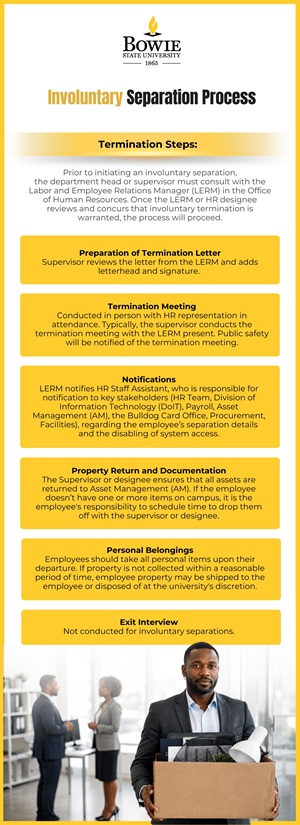
Prior to initiating an involuntary separation, the department head or supervisor must consult with the Labor and Employee Relations Manager (LERM) in the Office of Human Resources. Once the LERM or HR designee reviews and concurs that involuntary termination is warranted, the process will proceed.
1. Preparation of Termination Letter – Supervisor partners with the LERM or HR designee to draft a letter on department letterhead.
2. Termination Meeting – Conducted in person with HR representation in attendance. Typically, the supervisor conducts the termination meeting with the LERM present. Public safety will be notified of the termination meeting.
3. Notifications – LERM notifies the HR Staff Assistant, who is responsible for notifying key stakeholders (HR Team, Division of Information Technology (DoIT), Payroll, Asset Management (AM), the Bulldog Card Office, Procurement, Facilities) regarding the employee’s separation details and the disabling of system access.
4. Property Return and Documentation – The Supervisor or designee ensures that all assets are returned to Asset Management (AM). If the employee doesn’t have one or more items on campus, it is the employee's responsibility to schedule time to drop them off with the supervisor or designee.
5. Personal Belongings – Employees should take all personal items upon their departure. If property is not collected within a reasonable period of time, employee property may be shipped to the employee or disposed of at the University’s discretion.
6. Exit Interview – Not conducted for involuntary separations.
Voluntary Separation Protocol
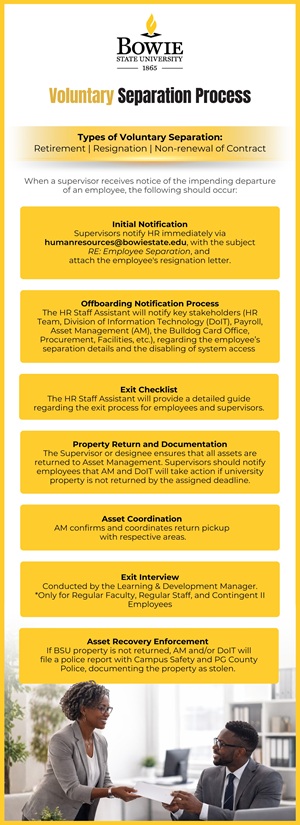
Types of Voluntary Separation
- Retirement
- Resignation
- Non-renewal of Contract
Termination Steps
When a supervisor receives notice of the impending departure of an employee the following should occur:
1. Initial Notification – Supervisors should notify HR immediately upon learning of the employee’s separation via humanresources@bowiestate.edu, with the subject RE: Employee Separation, and include the employee's resignation letter as an attachment.
2. Notifications – The HR Staff Assistant will notify key stakeholders (HR Team, Division of Information Technology (DoIT), Payroll, Asset Management (AM), the Bulldog Card Office, Procurement, Facilities, etc.), regarding the employee’s separation details and the disabling of system access.
3. Exit Checklist – The HR Staff Assistant will provide a detailed guide regarding the exit process for employees and supervisors.
4. Property Return and Documentation – The Supervisor or designee ensures that all assets are returned to Asset Management. Supervisors should notify employees that AM and DoIT will take action if university property is not returned by the assigned deadline.
5. Asset Coordination – AM/ DoIT confirm and log returns with their respective areas.
6. Exit Interview – Conducted by Learning & Development Manager. Exit data will be completed electronically to generate quarterly reporting information.
7. Asset Recovery Enforcement – If BSU property is not returned, AM and/or DoIT will file a police report with Campus Safety and PG County Police documenting the property as stolen.